 Skip to content


We had already told you everything about the characteristics and varieties of porcelain flooring here on the blog. We have given you tips and advice on the importance of choosing the right flooring when purchasing a property. Today we will talk about another material recommended by architects, not only in the structure of the property, but also in the composition of environments: marble.
When building or renovating, many construction companies – or even homeowners – opt for economical materials. But are these savings real, or do they end up being a “cheap that ends up being expensive”? Unfortunately, this is an unrealistic savings.
In addition to being one of the finishes that most expresses elegance and refinement, marble has a higher quality than other flooring. It is much easier to maintain, which generates savings in the long term. As it is a cold material, it is also ideal for compositions in tropical climates, since it helps to reduce heat.
Architecting
Considered by architects to be not only beautiful but also luxurious, marble is a versatile material that can be used to decorate various areas of your property: from flooring and wall coverings, to bathrooms and even common areas in buildings. Its use in small details is also common in contemporary architecture, as it transforms the simple into sophisticated.
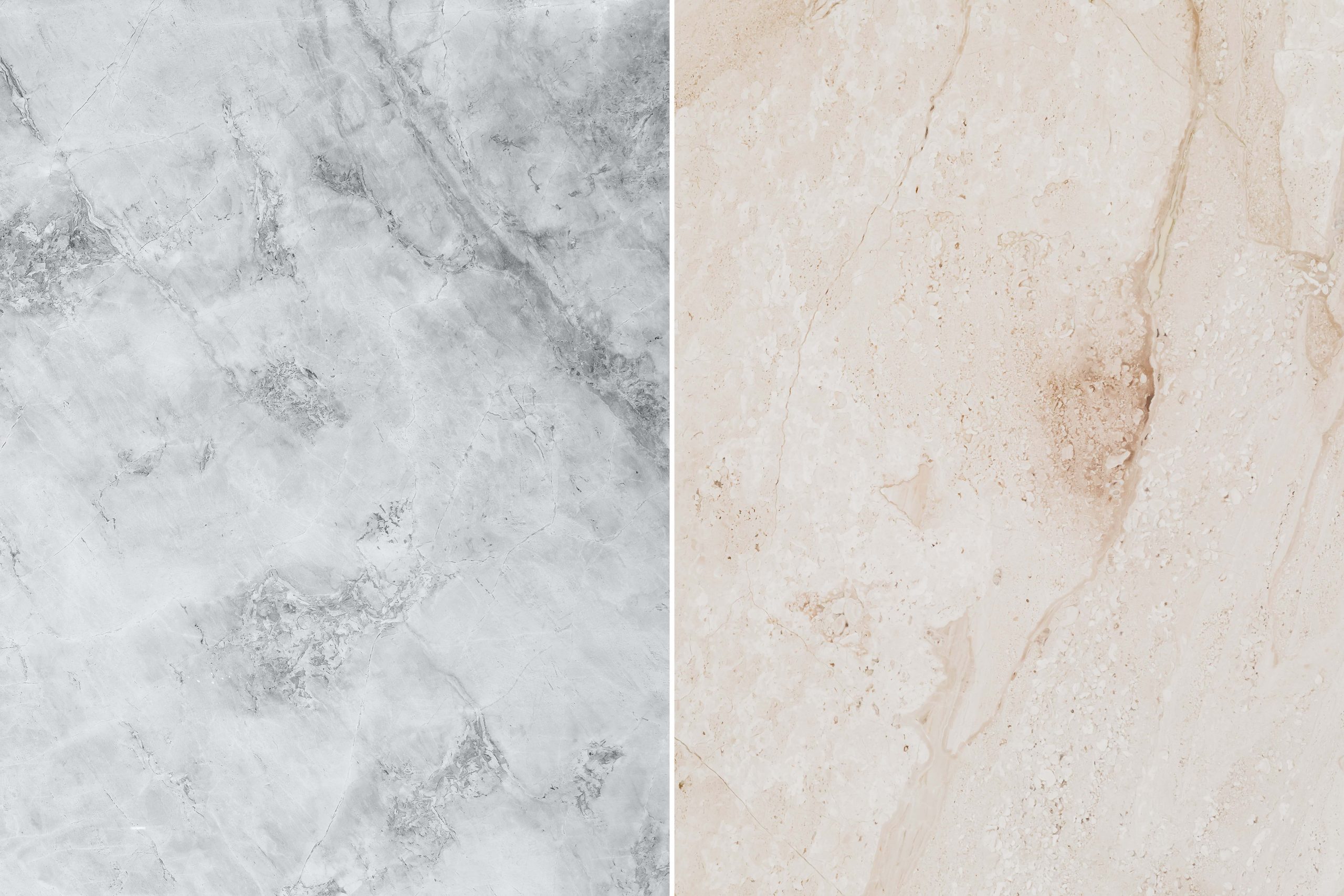
Its physical composition is also fascinating. Marble can be defined as a metamorphic rock, consisting mainly of calcite or dolomite. It is formed through high pressure and has variable grain sizes, often with colored veins, which results in its beautiful appearance. Historically, the material was used in classical sculptures and buildings, such as the famous Elgin Marbles.
Most used types of marble
There are a wide variety of marble types available today. Before we get into their classifications, let’s talk about the finishes:
- Gross: the marble does not receive any treatment, maintaining its original characteristics;
- Polished: the material receives a special treatment that leaves it shiny and smooth;
- Levigated: in this process the piece is sanded, giving it a smooth and uniform surface, but without shine;
- Sandblasted: also used on glass, this process consists of throwing sand at high pressure onto the surface, causing a rougher appearance;
- Flamed: the marble has a rough appearance due to a fire-based process;
- Spiked: here the stone undergoes a roughening process, giving it small reliefs and making it rougher and less slippery.
In Brazil alone, there are more than 20 types of variety. Here are five models to inspire you:
Carrara
Originating from the city of Carrara, Italy, this marble has a white color with gray veins. Used on countertops, walls and even ancient sculptures – such as Michelangelo's David – this marble is not only versatile but also elegant.
Piguês
Originating from Greece, Piguês marble is a type of sedimentary rock that has been used for centuries in temples and monuments.
Beige Bahia
Originating from the state of Bahia, also known as Brazilian Travertine, it is one of the most widely used in the country. It has a light beige color, making it easy to combine in decoration.
Travertine
Originating from Italy, it is considered the most widely used marble in construction and finishing. Its porous material allows it to be used preferably in indoor environments.
Verona
It has a characteristic shade of light and dark red tones. It is a noble marble that can be used for indoor environments where marble can have greater durability.
Did you like this post?
Access www.emplavi.com.br to learn about our projects and visit our blog to stay up to date with everything that happens in the real estate market, tips and much more!


